

Executive Summary for Travelers:
This report tracks Japan eSIM speed, latency, and real-world mobile network performance based on field tests in Tokyo, Osaka, and other major travel areas.
For travelers, eSIM speed in Japan is not only about the highest download Mbps. A good Japan eSIM should stay responsive while using maps, train route search, translation apps, messaging, social media, web browsing, and booking confirmations.
Connectivity Lab measures real-world Japan eSIM speed across busy urban environments such as stations, shopping areas, landmarks, indoor spaces, and residential zones. Today’s results show how a local Japan eSIM performs under practical travel conditions, including download speed, upload speed, ping, and latency.
🏛️ Today’s Monitoring: eSIM Network Performance
We conduct weekly checks at key Osaka locations to guarantee a lag-free digital experience for your journey.
| Target Zone | Test Spot | Network Status | Speed (Download) | Ping (Pulse) |
|---|---|---|---|---|
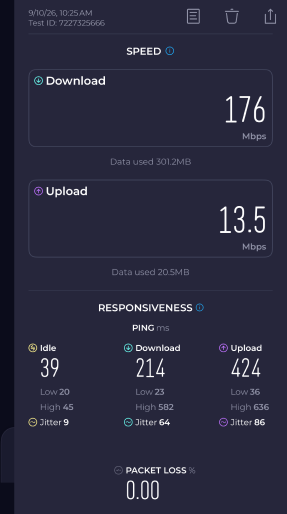
| Higashiosaka City, Osaka | Street | 🟢 Seamless | 176 Mbps | 39 ms |
How Fast Is eSIM in Japan?
Japan eSIM speed can vary by location, building type, crowd density, device model, and time of day. In real travel conditions, download speed and ping are usually more important than peak speed alone.
For most tourists, 10–20 Mbps is already enough for maps, messaging, browsing, translation apps, and train route search. Speeds above 30–50 Mbps usually feel comfortable for social media, video, image uploads, and daily travel use. Results above 100 Mbps indicate very strong mobile network performance.
Ping is also important. A lower ping makes apps feel more responsive when opening maps, refreshing routes, sending messages, or loading search results. This is why a Japan eSIM speed test should always include both Mbps and latency, not download speed alone.
As a practical guide:
| Speed or ping result | What it means for travelers |
|---|---|
| 10–20 Mbps download | Enough for maps, messaging, browsing, and travel apps |
| 30–50 Mbps download | Comfortable for most travel use |
| 100 Mbps+ download | Very strong mobile data performance |
| Under 50ms ping | Highly responsive for maps and messaging |
| 50–150ms ping | Usually usable for travel apps |
| 200ms+ ping | May feel delayed for real-time use |
A good Japan eSIM does not need to show the highest speed in every location. It needs to stay stable and responsive across the places travelers actually visit.
📸 Live Proof: Performance Logs
Transparent records from our field team. We test in real-time so you can travel with confidence.
[September 10, 2026] #Log 01: Higashiosaka City, Osaka
- Time: 10:25 JST
- Environment: On the street
- Test device: iPhone 17
- Network: au (KDDI Group) Japan Local Network
- Result
- Speed
- Download: 176 Mbps
- Upload: 13.5 Mbps
- Responsiveness (Ping)
- Idle: 39.0 ms
- Download: 214 ms
- Upload: 424 ms
- Speed
- Insight: General travel-related usage such as web browsing, navigation, and music streaming all performed smoothly. However, activities requiring heavier data usage—such as live streaming or video downloads—were relatively slower.
📉 Why Latency Matters: Local vs. Roaming
A “fast” connection is useless if it’s not “responsive.” The key is Latency (L).
Ltotal = Ldevice + Llocal_net + Lrouting + Lserver
- Global Brands (Airalo, Holafly, etc.): Your data travels through multiple international servers before reaching Japan, leading to 200ms+ delays (laggy maps, buffering).
- Native Japan eSIM: By connecting directly to Japan’s local infrastructure, we eliminate unnecessary routing, delivering a ~30ms “Pulse” for instant app response.
🧭 About This Benchmark
This page serves as the official Japan eSIM Live Speed Benchmark maintained by Connectivity Lab.
All tested plans are provisioned as 5G-enabled profiles, with automatic fallback to LTE when 5G coverage is unavailable. Measurements reflect real-world adaptive network behavior under live urban travel conditions.
Only the most recent verified field test session is displayed. On weekdays, data is typically updated on Mondays. On non-test days, the most recent dataset remains visible.
Previous daily measurements are removed to maintain clarity and performance efficiency. Historical data is consolidated in the Japan eSIM Weekly Speed Report.
🛠️ Connectivity Lab Methodology
Measurements are conducted in active urban environments using commercially available 5G-enabled devices.
Each test session records:
- Active connection type (5G or LTE fallback)
- Download throughput (Mbps)
- Upload throughput (Mbps)
- Latency (ms)
- Environmental context (indoor/outdoor, density level)
Testing is performed under live network conditions rather than controlled laboratory environments to reflect typical traveler usage scenarios.
📡 Network & Test Profile Specification
All measurements in this report were conducted on the au mobile network, one of Japan’s three major telecommunications operators.
According to the Opensignal Mobile Network Experience Global Awards 2026, au (KDDI) was named a Global Winner for Reliability Experience, achieving one of the highest scores worldwide.
The tested profile was au’s dedicated travel 5G eSIM, provisioned for short-term and inbound users.
Test SIM Configuration
- Network Provider: au (KDDI Group)
- Network Type: Native local access (non-roaming)
- Service Type: Travel 5G eSIM
- Data Plan: Unlimited data
Testing was performed using a native 5G-enabled profile with automatic LTE fallback where 5G coverage was unavailable.
Because the profile connects directly to the local network infrastructure (not international roaming), performance results reflect domestic network routing behavior under real-world urban travel conditions.
This configuration allows for accurate benchmarking of Japan’s commercial 5G mobile network performance from a traveler usage perspective.
Docomo vs SoftBank vs au: Which Network Matters for Japan eSIM?
Japan’s major mobile networks include Docomo, SoftBank, au, and Rakuten. Many travelers search for Docomo vs SoftBank eSIM comparisons before choosing a Japan eSIM, but the best choice depends on more than the network name.
For travel eSIM users, the practical difference usually comes down to coverage, indoor signal, congestion, routing, and latency. A plan connected to a strong local network can perform well for daily travel even when speeds vary by location.
| Network factor | Why it matters for Japan eSIM users |
|---|---|
| Coverage | Helps maintain data access across cities, transit areas, hotels, and tourist districts |
| Indoor performance | Important in stations, malls, restaurants, museums, and hotels |
| Latency | Affects how responsive maps, messaging, and route search feel |
| Upload speed | Important for video calls, photo uploads, and hotspot use |
| Local routing | Can reduce delays compared with international roaming routes |
| Congestion | Busy stations and landmarks may affect real-world speed |
Docomo, SoftBank, and au are all major Japanese mobile networks, but a traveler’s actual eSIM experience depends on the specific eSIM profile, routing structure, device compatibility, and local conditions at the time of use.
This report currently benchmarks a local Japan eSIM profile on the au mobile network. Results should be read as a real-world performance snapshot for this tested profile, not as a complete ranking of all Japanese mobile networks.
FAQ: Japan eSIM Speed Test
How fast is eSIM in Japan?
Japan eSIM speed depends on the local network, location, device, time of day, and whether the plan uses local access or roaming-based routing. In most travel situations, stable download speed above 10–20 Mbps is enough for maps, messaging, browsing, and translation apps. Higher speeds are useful for video, hotspot, and large uploads.
What is a good eSIM speed in Japan?
For everyday travel, 30–50 Mbps download speed is already comfortable. Speeds above 100 Mbps indicate very strong mobile performance. However, ping and latency are also important because they affect how responsive apps feel.
Is Docomo or SoftBank better for Japan eSIM?
Docomo and SoftBank are both major Japanese mobile networks, but the better choice depends on the specific eSIM plan, coverage area, routing, congestion, and device compatibility. For travelers, real-world performance is more useful than brand comparison alone.
Is au good for Japan eSIM?
au is one of Japan’s major mobile networks. This report currently benchmarks a local Japan eSIM profile on the au mobile network and records real-world speed, ping, latency, and travel usability across active urban environments.
Why is ping important for Japan eSIM speed?
Ping measures how quickly the network responds. Low ping helps maps, messaging, route search, web browsing, and travel apps feel faster. A connection with high Mbps but poor latency may still feel slow in real use.
Why can eSIM speed change by location in Japan?
eSIM speed can change depending on indoor or outdoor conditions, building materials, crowd density, network congestion, device model, and whether the connection is using 5G or LTE fallback.

Head of Network Data Science
Soorim Go
"Translating real-world signal strength into reliable performance metrics."
Soorim Go is the Head of Network Data Science at Connectivity Lab, where she oversees field data acquisition, network performance measurements, and the refinement of connectivity datasets.

